



Lead Time Reduction – The Real Competitive Advantage of Modern Manufacturing Businesses
In today’s market, customers care about more than just price and quality.
What truly matters is: RESPONSIVENESS
Businesses with shorter lead times are often able to:
- Win more orders
- Respond faster to market changes
- Reduce inventory levels
- Improve cash flow
- Increase customer satisfaction
On the other hand, long lead times often result in:
- Lost business opportunities
- Missed urgent orders
- Excessive inventory
- Slow decision-making
- Hidden operational costs
Through many improvement projects, ALC has observed that the actual value-added time in production usually represents only a very small portion of the total lead time. Most wasted time comes from waiting, poor coordination, and overly complex processes.

Why Has Lead Time Reduction Become a Critical Survival Requirement?
Due to changes in the global business environment and geopolitical factors, market demands are shifting rapidly:
- Smaller order quantities
- Faster delivery expectations
- More frequent changes
- Higher cost pressures
In this environment, businesses can only remain competitive through: EXECUTION SPEED.
Companies with shorter lead times gain advantages such as:
- Winning urgent orders
- Collaborating with larger customers
- Reducing inventory levels
- Increasing cash turnover
- Improving net profit margins
- A Practical Example
In Vietnam’s garment industry, the average time required to complete an order (once materials are available) is approximately 21 days. If a business operates with a longer lead time, it means the company is already losing competitive advantage.
Reducing lead time does not simply help businesses work faster — it helps them operate smarter, more flexibly, and more efficiently.
Why Do Many Lead Time Reduction Projects Fail?
Through various implementation projects, ALC has identified several common mistakes:
- Improving production only while ignoring information flow
- Optimizing individual departments instead of the entire value chain
- Failing to address the true bottlenecks
- Not changing decision-making processes
- Maintaining excessive stock and buffer inventory mindsets
Result: isolated improvements may occur, but overall lead time remains unchanged.
The ALC Difference in Lead Time Reduction Projects
In manufacturing businesses, operational performance depends on three critical flows:
- Cash Flow
- Material Flow
- Information Flow
Many Lean programs focus only on material flow.
ALC focuses heavily on information flow — the key factor that determines operational speed, smooth coordination, and overall responsiveness. We help businesses optimize critical processes such as:
- Order processing flow from order receipt to shipment
- Product development processes
- Purchasing and payment processes
- Internal decision-making workflows
Because in reality: Orders are often delayed not because production is slow, but because decisions are slow.
How ALC Implements Lead Time Reduction Projects
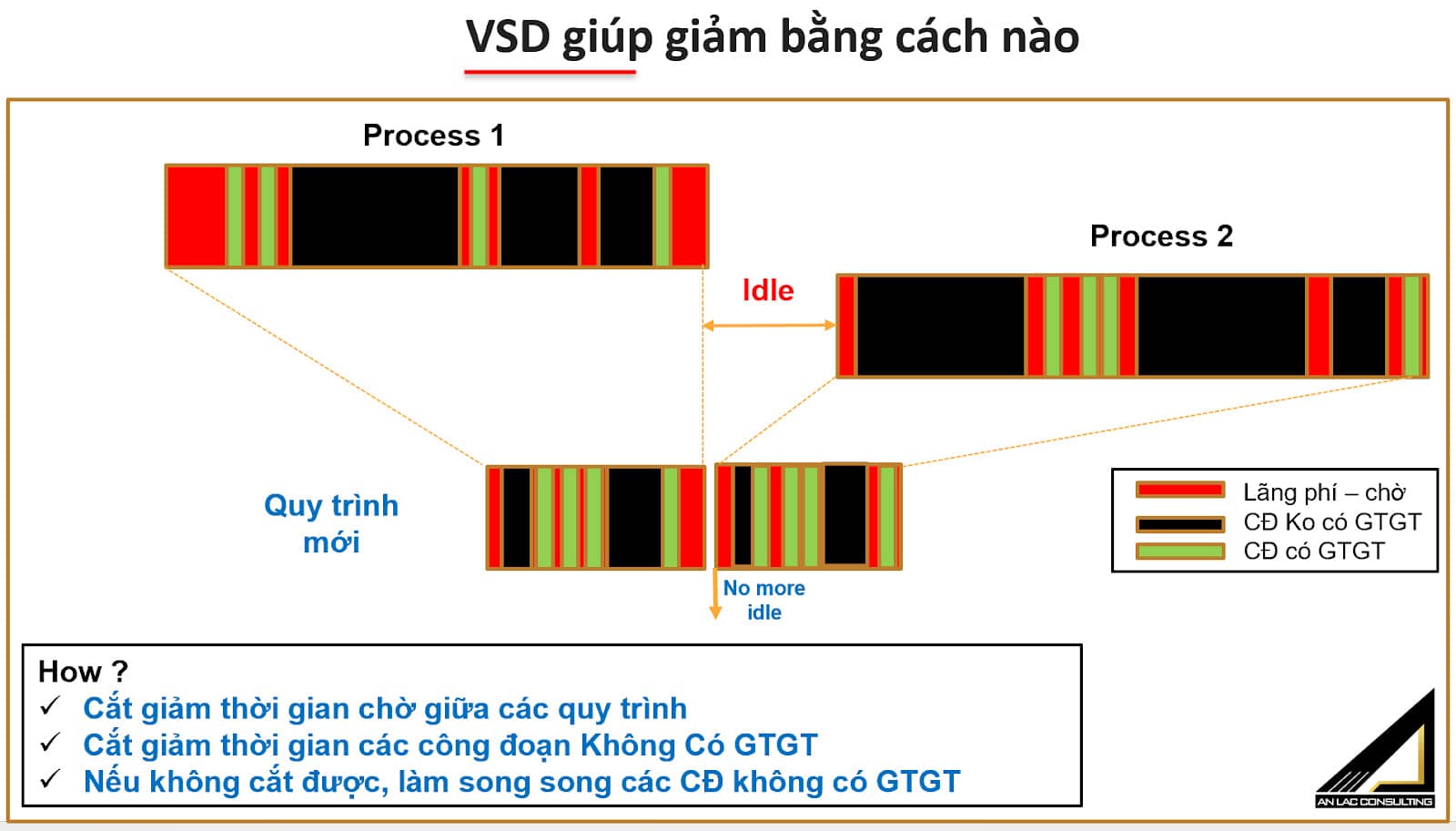
ALC does not stop at Value Stream analysis. Our consultants work directly at the Gemba to:
- Identify real bottlenecks and uncover root causes
- Analyze waiting time throughout processes
- Eliminate non-value-added activities
- Redesign workflow processes together with the business team
- Coach operational teams during implementation
Unlike consulting programs that stop at analysis, ALC focuses on:
CONSULTING + IMPLEMENTATION + KNOWLEDGE TRANSFER
After the project, businesses do not just achieve shorter lead times — they gain the capability to continuously improve on their own.
When Should a Manufacturer Start a Lead Time Reduction Project?
Businesses should consider implementing a project when:
- Lead times are longer than competitors
- Delivery speed is a key customer requirement
- Inventory levels are too high
- Approval processes are slow
- Information between departments is not synchronized
- Departments operate in disconnected silos
If your business is experiencing these signs, lead time reduction is no longer optional — it is a critical survival factor.
Start Your Lead Time Reduction Journey with ALC
ALC can begin with an on-site operational assessment to:
- Measure actual end-to-end lead time
- Identify the biggest bottlenecks
- Detect quick wins
- Propose a practical improvement roadmap
ALC does not simply help businesses move faster — we help businesses become more agile and adaptable.
ALC – Your Partner in Accelerating Operational Capability
With hands-on implementation experience across multiple manufacturing factories, ALC helps businesses:
- Reduce operational lead time
- Increase market responsiveness
- Improve cash flow
- Build flexible operational systems